NuriEdge | Guests of Becoming
What If Knowing What to Do Isn’t the Same as Being Able to Do It?
There is a particular kind of frustration that comes with knowing better and still not doing better.
You know you shouldn’t send the email while you’re angry.
You know the conversation will go better if you slow down first.
You know the pattern.
You may even know exactly what you should do instead.
And then something happens.
Stress rises. Your bandwidth disappears. The old response takes over.
And afterward, you wonder:
Why did I do that again?
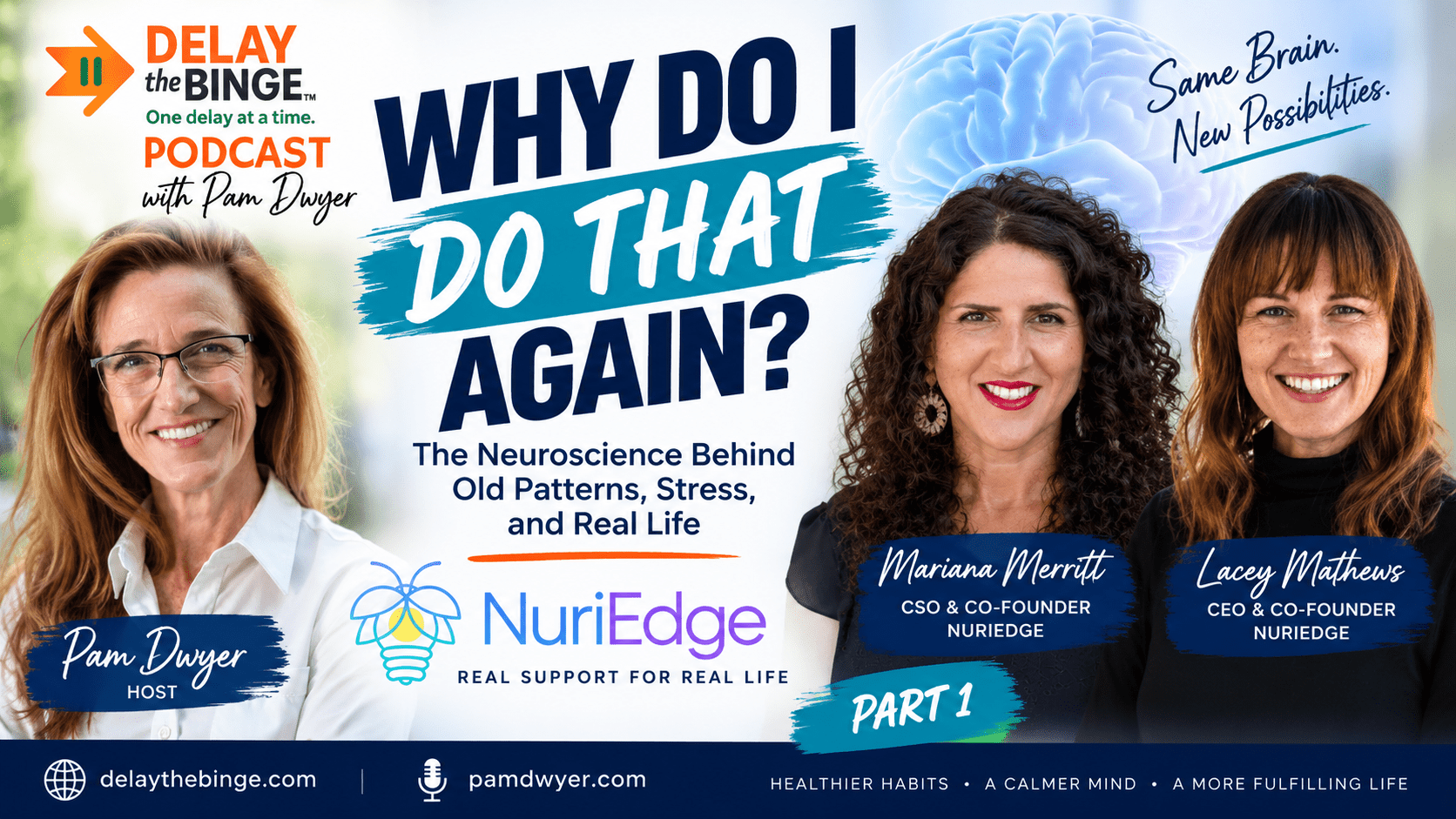
That question sits at the heart of so much of my work with Delay the Binge™. It is also what made my conversation with Mariana Merritt and Lacey Mathews, co-founders of NuriEdge, feel so familiar.
Because the problem isn’t always that we don’t know what to do. Sometimes we simply can’t access what we know when we need it most.
Across this two-part conversation, we explored what happens inside us when stress, pressure, old patterns, and limited bandwidth collide with our best intentions.
But we also talked about something I think matters even more.
What happens next.
Because sometimes you catch the pattern before you react. Sometimes you catch it in the middle. And sometimes the pause doesn’t come until afterward.
The pause still counts.
You don’t have to start over. You start where you left off.
▶ Watch the Conversations
Part 1: Why You Fall Back Into Old Patterns When You’re Stressed | NuriEdge Part 1
Part 2: How to Break Old Patterns Even After You React | NuriEdge Part 2
Listen Everywhere
Prefer to listen?
Both conversations are available on Apple Podcasts, Spotify, Amazon Music, YouTube, and everywhere podcasts are available.
In These Conversations
Together we explore:
- Why knowing what to do and being able to access that knowledge under stress are two different things.
- How stress, activation, and limited bandwidth can make familiar patterns easier to fall back into.
- Why capable, self-aware people can still find themselves asking, “Why did I do that again?”
- What psychological safety actually looks like during difficult workplace moments.
- Why middle managers can experience a unique kind of isolation while supporting the people below them and answering to the people above them.
- How even a brief pause can create enough space for a different response.
- Why hindsight is useful, but support before a difficult conversation can help us practice a different response before the old pattern takes over.
- How AI can create a different kind of space for self-reflection and pattern recognition.
- Why people sometimes disclose thoughts and fears differently when they aren’t socially monitoring another person’s reaction.
- How NuriEdge approaches privacy and psychological safety for employees using the platform.
- What happens when the workplace itself is contributing to stress and depletion.
- Why personal growth doesn’t mean pretending an unhealthy environment is healthy.
- What repair can look like after we’ve already reacted.
- Why resilience isn’t a destination we finally reach.
- How learning to recover, recalibrate, and return can be as important as preventing the reaction in the first place.
One of the things that fascinated me was Mariana’s explanation of how traditional support often happens after an event. We look backward and dissect what happened. With on-demand AI, someone can also prepare before a difficult interaction, identify what has happened in similar situations, and practice approaching it differently.
We also talked about the patterns we may not see ourselves. Lacey and Mariana described how people sometimes share fears or self-talk with AI that they might filter when talking with another human, giving them another opportunity to recognize what they’re carrying into a situation.
One Moment That Stayed With Me
There were plenty of moments in these conversations that made me think differently.
But the one I kept returning to was surprisingly simple.
Sometimes the pause comes afterward.
I have spent years thinking about behavior change.
I know what it feels like to make tremendous changes in your life and still find yourself doing something you know doesn’t serve you.
Food. Work. Scrolling. People pleasing. Reacting.
Whatever our pattern happens to be. And for a long time, I interpreted those moments as failure.
I know better. Why am I still doing this? I thought I had changed.
But maybe we have been measuring progress at the wrong moment. We tend to celebrate catching ourselves before the reaction. And yes, that’s wonderful. But what if you don’t? What if you already sent the email? What if you already raised your voice? What if you already said yes when you meant no?
What if you already ate the thing, bought the thing, drank the thing, worked another three hours, or fell straight back into the response you promised yourself you wouldn’t repeat?
You are still allowed to pause. You can notice what happened. You can get curious instead of condemning yourself. You can repair what needs repairing. You can ask what you want to do differently next time. And then you can make the next intentional choice. That isn’t starting over. That is continuing.
And perhaps that is one of the most important things resilience asks us to learn.
We don’t go back to zero.
About NuriEdge
NuriEdge is an AI-powered professional coaching platform designed to bring practical support closer to the moments when people actually need it.
Rather than limiting reflection to what happens after a difficult interaction, NuriEdge gives users a space to prepare for challenging conversations, recognize recurring patterns, explore different responses, reflect on what happened, and practice strategies they may be able to use next time.
The platform brings together technology, behavioral insight, neuroscience-informed strategies, reflection, role play, and practical tools designed to support individuals, teams, and leaders in real-world situations.
An important part of that design is privacy. Mariana explained that individual conversations with NuriEdge are not shared with a user’s supervisor. Organizational leaders receive aggregated information rather than access to individual conversations, with safeguards intended to protect confidentiality and psychological safety.
NuriEdge isn’t about replacing human connection or creating dependence on AI. As Mariana explained during our conversation, the intention is for the technology to facilitate the user’s own growth and relationship with themselves.
About Mariana Merritt
Mariana Merritt is the CSO and Co-Founder of NuriEdge.
A strategic education executive and social-impact entrepreneur, Mariana has more than a decade of experience designing and scaling mental health and behavioral-support programs.
Her work has included leading national EdTech initiatives, developing engagement frameworks, and helping organizations think differently about trauma-informed support.
At NuriEdge, Mariana brings her experience with human behavior and neuroscience into the development of practical tools designed to help people understand stress, recognize patterns, strengthen resilience, and respond more intentionally in the moments that matter.
About Lacey Mathews
Lacey Mathews is the CEO and Co-Founder of NuriEdge.
With more than 18 years of experience turning complex ideas into scalable products, Lacey brings the technology and product-development side of the NuriEdge partnership.
She is a three-time entrepreneur and founder whose work focuses on creating practical tools that help individuals and organizations access useful strategies closer to the moment they need them.
At NuriEdge, her work sits at the intersection of technology, behavioral intelligence, neuroscience, and sustainable performance.
Guest Quotes
“It’s a safe space, truly.”
— Mariana Merritt
Mariana used those words while describing what can happen when people have room to examine their own behavior without the social monitoring that can occur in conversation with another person.
And one idea from the conversation became a thread running through both episodes:
Resilience isn’t a destination. It’s something we continue to practice.
Connect with NuriEdge
NuriEdge
nuriedge.ai
Visit the website to learn more about the platform, explore the NuriEdge podcast, and start a free trial.
LinkedIn
NuriEdge
Lacey Mathews
Connect with Lacey on LinkedIn
Mariana Merritt
Connect with Mariana on LinkedIn
🎙 Behind the Mic
After every conversation, I spend a few minutes sharing what stayed with me after the microphones were turned off. And with Mariana and Lacey, I kept coming back to one question:
What if we’ve been expecting ourselves to get behavior change right too early in the process?
We celebrate the pause that happens before the reaction. But sometimes awareness arrives five minutes too late. And I don’t think that makes the awareness meaningless. Maybe part of sustainable change is learning to recognize the pattern wherever we happen to catch it.
Before. During. After.
Because every time we notice, we gather information. Every time we return, we practice returning. And every intentional choice that follows gives us another opportunity to strengthen who we’re becoming.
▶ Watch Behind the Mic
Continue the Journey
Every Tuesday I share a true story from my life as PJ Hamilton.
Every Wednesday I step Behind the Mic to unpack what these conversations are teaching me.
Every Thursday a new Delay the Binge™ episode goes live.
Together, they’re designed to help you pause long enough to notice the patterns quietly shaping your life, understand what they may be costing you, and discover the small choices that help you keep becoming.
A Personal Note from Pam
For a long time, I thought change should eventually become proof.
Proof that I had learned. Proof that I was stronger. Proof that the old pattern no longer had power over me. And then life would happen. I would know what to do and still do something else.
Those were the moments when I was most likely to tell myself I had failed. This conversation reminded me that knowing better isn’t always the same thing as having access to our best thinking in the moment.
Stress matters. Capacity matters. Patterns matter. And what we do after the moment matters too. Maybe progress isn’t never reacting again. Maybe progress is recognizing ourselves sooner, understanding ourselves better, repairing when we need to, and learning how to return.
Sometimes the pause comes before. Sometimes it comes during. Sometimes it comes after.
The pause still counts.
You haven’t erased everything you’ve learned. You haven’t gone back to zero. Start where you left off.
Pause. Choose. Build momentum. Finish stronger.
— Pam Dwyer
 Previous Post